

What Are the Early Warning Signs of Retinal Problems?
Your eyes are a complex natural mechanism—a camera. The retina acts as a light-sensitive film. It converts light into signals for the brain, giving us the unique ability to see the world. Sometimes problems with the retina occur, leading to severe vision compromise. Many diseases creep up unnoticed and cause no pain in the early stages. Those with diabetes or a hereditary predisposition to eye diseases should be especially vigilant. See an ophthalmologist regularly for regular checkups. We’ll discuss the main symptoms of retina problems so you know when to see a doctor. Read this article to recognize the first warning signs and save your vision.
The Retina: A Unique Mechanism
We live in an era of ultra-sharp screens and perfect images. But our vision is our most valuable and fragile “display.” Its function depends on the retina’s health. This thin inner layer of the eye is a natural processor. It converts light into neural signals, creating a picture of the world before us. When the retina begins to deteriorate, this process may go unnoticed.
Warning Signs of Common Retinal Problems
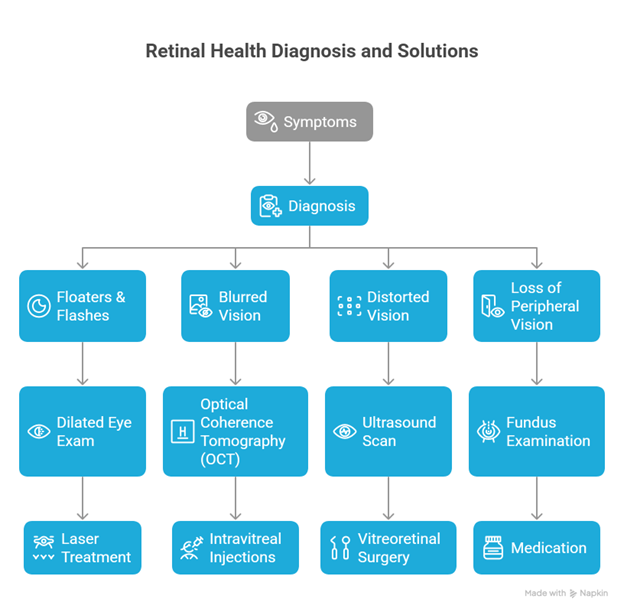
If you notice such signs, do not delay a consultation with a specialist! Blurred vision – a sudden or gradual increase in blur in front of one or both eyes often indicates retinal problems. Diabetic retinopathy or age-related macular degeneration are dangerous conditions.
Have you noticed “spider webs,” spots, or flashes in your vision? Occasional floaters are common. But if you suddenly see a swarm of spots, sparks, or lightning, especially from the side, don’t delay! This could be a sign of incipient retinal detachment. This situation requires immediate medical attention. Sometimes patients notice distorted vision. Straight lines appear wavy, and door frames appear curved. This symptom is typical of edema or changes in the central retina.
If you experience difficulty finding your way around in the dark or have difficulty distinguishing the outlines of objects in low light, consult a doctor. Unfortunately, this could be a sign of retinal dystrophy.
Do the colors of the world suddenly lose their vibrancy, become faded, or do you confuse similar colors? This severe symptom is associated with some macular diseases. Is a blurry, dark spot appearing in the center of your visual field? Are you having trouble reading, distinguishing faces, or fine details? This is a clear sign of macular degeneration.
Do you feel like you’re looking through a telescope or like a curtain has fallen over your eyes? Loss of peripheral vision is also common. This can be a sign of retinal detachment and other dangerous conditions.
When Should You See a Doctor Immediately?
Don’t neglect routine checkups. But in some cases, delay is essential. Seek immediate medical attention if you experience sudden flashes of light or a sharp increase in the number of “floaters.” The first warning signs can be deceptively subtle: lines on tiles appear slightly curved, and a shadow flickers in the corner of your vision, disappearing as soon as you focus. Perhaps you’ve noticed an increase in the number of “floaters” before your eyes? Are you haunted by brief flashes of light, like the glare of distant headlights? These symptoms are insidious. They appear and disappear, dulling our vigilance. When vision changes noticeably and persistently, take action!
So, don’t delay if you experience an opaque “curtain” or a dense shadow before your eyes. And of course, see a doctor immediately if your vision suddenly and significantly deteriorates. The success of treatment and the possibility of preserving your vision often depend on the speed of your reaction.
What Are the Common Retinal Problems?
Thinning and tears at the edges of the retina are common. People with myopia are particularly susceptible to this, and if treatment is not taken promptly, detachment can occur. Retinal detachment is a serious emergency. It’s as if a black curtain or veil appears before the eye, and vision deteriorates sharply. Every hour counts, and urgent surgery is needed.
With age, especially after age 50, the central part of the retina (macula) can be damaged. This is called age-related macular degeneration. The “dry” form develops slowly, while the “wet” form develops rapidly and significantly reduces vision, distorting straight lines.
In people with diabetes, high blood sugar can damage the small blood vessels that supply the retina. This complication is called diabetic retinopathy, which can lead to hemorrhages and vision impairment.
Edema—fluid accumulation—can also develop in the center of the retina. This symptom often accompanies diabetes, venous thrombosis, or inflammation, and makes the image blurry.
Who Should Be Especially Vigilant?
The risk of retinal damage is higher in the following cases:
- Living with diabetes
- Having close relatives with retinal diseases
- Suffering from high myopia
- Having had an eye injury or surgery
- Over 50 years old
However, the problems are affecting younger people. Unfortunately, ophthalmologists are increasingly seeing retinal damage in young people. This damage can be associated with extreme visual stress, vascular disorders, and the consequences of inflammatory processes.
The Future of Retina Problems Diagnosis
Modern medicine has learned to look deep into the retina. Optical coherence tomography detects microscopic changes at the cellular level before they affect visual acuity. With the advent of artificial intelligence in diagnostics, analyzing these images and identifying even the slightest abnormalities has become more accurate and faster.
The retina does not tolerate delay. Many retina diseases are now successfully treated. Specialists use laser technologies, injection methods, and microsurgery. But the key to success is acting quickly. Early intervention preserves vision.
Conclusion
Recognize the signs of retinal problems as early as possible. So, see your doctor regularly. He will be able to notice even the slightest changes in time. Choose a clinic you trust. Dr. Darryl G. Moffett, a retinologist-surgeon, has completed specialized training and has dedicated his career to preserving and protecting vision. He has many years of experience since 1993 and is committed to the most advanced surgical and diagnostic technologies.
His approach is based on patient education. You should understand your condition and feel supported.
Have you noticed any problems? Looking for a solution to your eye retina problem? Schedule a consultation with us and receive an accurate assessment of your retina and a treatment plan.
Delivering specialized care for retinal vision problems in Idaho, Western Wyoming And Southwestern Montana.
Get In Touch
- 3544 E. 17th, Suite 105
Ammon, ID 83406
Open in Maps - Phone: 208-535-4900
- Fax: 208-535-4906
- tetonretinal@gmail.com